
Introduction
Copper tube bending is a crucial process in various industries, including HVAC, plumbing, and industrial applications. However, bending copper tubes can introduce stress and deformation, leading to potential weaknesses, cracks, and dimensional inaccuracies. To maintain structural integrity and performance, it is essential to implement techniques that minimize stress and deformation during the bending process. This article explores effective methods for reducing stress and deformation in copper tube bending.
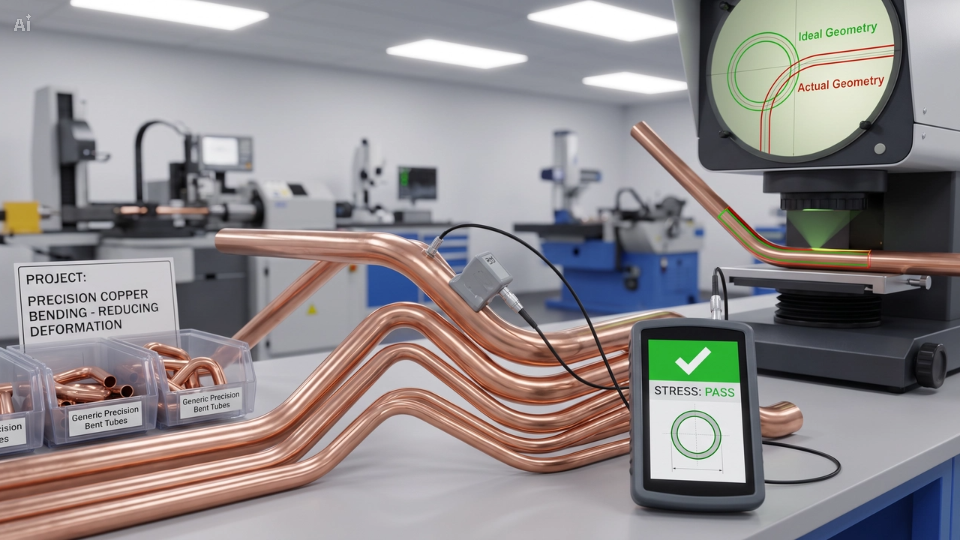
Understanding Stress and Deformation in Copper Tube Bending
During bending, copper tubes undergo various mechanical forces that can lead to:
- Springback: The tendency of the tube to return to its original shape after bending.
- Wall Thinning: The reduction in wall thickness at the outer bend radius.
- Ovality: The distortion of the tube’s circular cross-section.
- Cracking and Fracturing: Caused by excessive stress beyond the material’s elasticity limits.
Addressing these issues requires precise control of bending parameters, tooling, and material properties.
Best Practices for Reducing Stress and Deformation
1. Selecting the Right Copper Alloy
Different copper alloys exhibit varying levels of ductility and workability. Choosing the right alloy can enhance bendability and reduce stress:
- C12200 (DHP Copper): Ideal for HVAC and plumbing due to high ductility.
- C10200 (Oxygen-Free Copper): Provides excellent conductivity but requires careful bending to prevent cracking.
- C11000 (Electrolytic Tough Pitch Copper): Suitable for electrical applications but prone to work hardening.
2. Using Proper Bending Techniques
Several bending methods can be used to minimize stress and deformation:
- Mandrel Bending: Inserting a mandrel inside the tube prevents wall collapse and ensures uniform bending.
- Rotary Draw Bending: Provides controlled and precise bends, reducing ovality.
- Compression Bending: Useful for simple bends but requires careful control to avoid excessive thinning.
- Roll Bending: Ideal for large-radius bends, distributing stress more evenly.
3. Optimizing Bending Radius and Angle
A larger bending radius reduces stress concentration and deformation. Best practices include:
- Using a Bend Radius of At Least 1.5x the Tube Diameter: Minimizes wall thinning and ovality.
- Avoiding Sharp Bends: Gradual bends distribute forces more evenly.
- Employing Multi-Radius Bends: Helps prevent excessive stress accumulation in complex geometries.
4. Controlling Bending Speed and Force
The rate at which the tube is bent significantly affects stress levels:
- Slow and Steady Bending: Reduces the risk of cracking and allows material to adjust gradually.
- Uniform Application of Force: Prevents localized stress points that can lead to deformation.
- Hydraulic and CNC-Controlled Bending Machines: Ensure consistent and precise bending operations.
5. Preheating the Copper Tubes
Heating copper tubes before bending can enhance flexibility and reduce internal stress:
- Using Induction Heating or Open-Flame Torches: Softens the material for easier bending.
- Maintaining Optimal Heating Temperatures: Avoid overheating, which can weaken the material.
- Annealing Post-Bending: Relieves residual stress and restores ductility.
6. Using Lubrication to Reduce Friction
Lubricants play a crucial role in preventing surface defects and reducing stress during bending:
- Applying High-Quality Bending Lubricants: Reduces friction between the tube and bending die.
- Ensuring Even Lubrication Coverage: Prevents localized stress points.
- Selecting the Right Lubricant for Copper: Avoids contamination and ensures compatibility.
7. Employing Support Tools and Fixtures
Proper support tools prevent excessive deformation and ensure accurate bending:
- Mandrels and Wiper Dies: Prevent wall collapse and wrinkling.
- Clamp Blocks and Pressure Dies: Secure the tube in place to maintain consistency.
- Forming Rollers for Large Bends: Distribute stress evenly across the tube.
8. Implementing Non-Destructive Testing (NDT)
Post-bending inspections help detect stress-related defects:
- Eddy Current Testing: Identifies cracks and inconsistencies in tube structure.
- Ultrasonic Thickness Measurement: Ensures uniform wall thickness.
- X-Ray and Visual Inspections: Detect hidden deformations and surface defects.
9. Minimizing Work Hardening
Repeated bending can lead to work hardening, making the tube brittle:
- Annealing Between Bending Stages: Restores ductility and reduces internal stress.
- Limiting Excessive Re-Bending: Reduces the risk of material fatigue.
- Choosing Softer Tempers for Complex Bends: Enhances flexibility and reduces breakage risk.
10. Precision Measurement and Quality Control
Maintaining dimensional accuracy ensures minimal stress impact:
- Using Coordinate Measuring Machines (CMMs): Provides high-precision measurements.
- Laser Profiling Systems: Ensure accurate bend angles and radii.
- Tolerance Verification: Ensures compliance with industry standards such as ASTM B88 and EN 1057.
Challenges in Reducing Stress and Deformation
Despite best practices, challenges remain in minimizing stress and deformation:
- Springback Compensation: Requires precise adjustments based on material properties.
- Tool Wear and Maintenance: Regular inspection ensures consistent bending performance.
- Environmental Factors: Temperature and humidity can influence material behavior during bending.
Future Innovations in Copper Tube Bending
Advancements in technology continue to improve bending precision and reduce stress:
- AI-Driven Bending Optimization: Predicts stress points and adjusts parameters accordingly.
- Robotic and CNC Automation: Enhances repeatability and consistency in large-scale production.
- Smart Lubrication Systems: Automatically adjust lubricant application based on bending conditions.
- Advanced Material Coatings: Reduce friction and improve bending performance.
Conclusion
Reducing stress and deformation in copper tube bending requires a combination of proper material selection, precise bending techniques, lubrication, and quality control measures. By optimizing bending parameters and utilizing advanced technologies, manufacturers can ensure high-quality, defect-free copper tubes suitable for various industrial applications. Continuous innovation in bending methods and material science will further enhance efficiency and precision in the future.